
회전기기 결함 진단을 위한 비지도 클러스터링 및 도메인 적응 프레임워크 개발
스마트 팩토리에 활용 가능
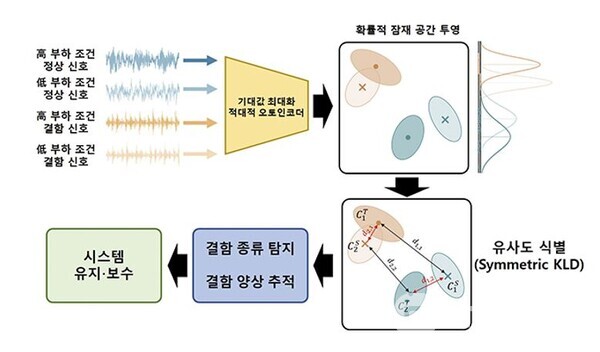
국내 연구진이 회전기기의 결함을 스스로 탐지하고 추적하는 인공지능(AI) 기술을 개발했다.
포스텍(POSTECH∙총장 김무환)은 기계공학과 이승철 교수와 통합과정 김태완 씨 연구팀이 회전기기의 결함을 다양한 운전 조건에서도 스스로 탐지하고 추적하는 인공지능 기술을 개발했다고 22일 밝혔다.
회전기기는 다양한 산업에서 꼭 필요한 핵심적인 장치로 제조 공장, 발전소뿐만 아니라 자동차, 항공기 등 수많은 산업 분야에 사용되고 있다. 회전기기의 결함은 치명적인 비용 손실과 안전 문제로 나타나며, 이를 사전에 방지하기 위해 회전기기의 결함을 진단하는 연구들이 많이 진행됐다.
다양한 결함 종류에 대한 물리적인 이해와 실험을 통해 회전기기의 결함 특성을 찾아 활용해 왔다. 최근에는 AI 기술이 결함 탐지에 활용되어 우수한 결과들을 보여 왔지만, 실제 고장 데이터 확보가 필요하며 지속해서 변화하는 운전 환경을 잘 반영하지 못한다는 한계가 있었다.
연구팀이 개발한 결함 탐지 및 추적 인공지능 모델은 기존 회전기기 진단의 한계점을 비지도 학습을 통해 극복했다. 오토인코더(Autoencoder) 기반의 인공지능 모델을 통해 회전기기로부터 측정되는 신호를 압축하고, 압축된 신호 간 유사도를 계산하는 방식을 통해 서로 다른 유형의 결함을 식별하고 추적할 수 있도록 하였다. 이 기술은 작동 조건이 다른 환경에서도 회전기기의 결함 유무 및 결함 종류를 정확하게 탐지한다. 특히 회전기기의 회전 속도가 50% 이상 차이가 있어도 효과적으로 결함을 탐지할 수 있다.
이승철 교수는 “이번 연구 결과는 최근 산업계에서 주목받는 ‘스마트 팩토리’에 적용될 수 있는 기술로, 공장에서 쏟아져 나오는 수많은 데이터를 인간의 개입 없이 비지도 학습을 통해 처리할 수 있다"며 "장비, 시스템의 상태를 감시하고 건강 상태를 추적하고, 이를 바탕으로 최적의 유지·보수 전략을 결정하는 데 사용할 수 있다”고 말했다
해당 연구는 컴퓨터과학·산업공학 분야의 세계적 권위지인 ‘국제전기전자기술자협회 산업정보학학회 논문지(IEEE Transactions on Industrial Informatics)’ 2022년 12월 12일자에 게재됐다.
[Summarizing in English]
POSTECH Research Team Discovers Unsupervised Clustering and Domain Adaptation Framework for Rotating Machinery Fault Diagnosis
On February 22, POSTECH Research Team, led by Prof. Seungchul Lee discovers "A Novel Unsupervised Clustering and Domain Adaptation Framework for Rotating Machinery Fault Diagnosis". The study online published by IEEE Transactions on Industrial Informatics on 12 December 2022, and the abstract of study is: Deep learning-based fault diagnosis methods require a large number of labeled datasets. However, considering the changing operating conditions, it is impractical to obtain labeled datasets for all cases. Therefore, this study proposes a new unsupervised clustering and domain adaptation framework to circumvent data deficiency and domain issues. The proposed framework comprises two steps: unsupervised clustering and domain adaptation. In the unsupervised clustering, an expectation-maximization adversarial autoencoder, which combines an expectation-maximization algorithm with an adversarial autoencoder, is used for feature extraction and subspace mapping. Subsequently, the mapped features are clustered using a Gaussian mixture model. In the domain adaptation, a domain synchronization that is based on the symmetric Kullback-Leibler divergence metric is used to infer the relationship between the source and target domain clusters. The experiments on two rolling-element-bearing datasets validate the effectiveness of our method. Specifically, our method performs domain adaptation without retraining, which is promising for real industrial applications.
관련기사
- UNIST-POSTECH, 나노섬유 멤브레인 활용한 혈액-뇌 장벽 모델 개발
- 포스텍, 고성능 플렉서블 패널용 박막트랜지스터 개발
- POSTECH, 안압 진단하고 안약까지 투여해주는 콘택트렌즈 개발
- 글로벌 음성분석 시장...2031년 6.4조 규모
- 핀란드 IQM, 西 양자컴퓨터 1호기에 연산 장치 제공
- 3월 티오베(Tiobe) 프로그래밍 언어 순위...파이썬 부동의 1위
- 포스텍, 아파트 보일러가 이산화질소 주요 배출원
- 포스텍∙조지아텍 연구팀, 약물 독성 관찰용 '체외 3D 인공 심장' 제작
- 포스텍, 백금 부식 완화로 연료전지 수명 늘려
- 포스텍, 세계 최대 정보량의 ‘메타홀로그램’ 구현