
인간 혈액-뇌 장벽을 모사하여 뇌질환 치료제 개발에 활용
UNIST(총장 이용훈)는 바이오메디컬공학과 박태은 교수 연구팀과 POSTECH(총장 김무환) 기계공학과 김동성 연구팀은 생체 기저막을 모사한 나노섬유 멤브레인을 활용한 기능성 혈액-뇌 장벽 모델을 개발했다고 15일 밝혔다.
혈액-뇌 장벽은 혈관내피세포와 그 주위를 둘러싸 지탱하는 기저막, 별아교세포, 그리고 혈관주위세포로 이루어진 생체 장벽으로 뇌 기능에 필수적인 물질만 출입을 허용하여 외부 물질의 침입으로부터 뇌를 보호하는 역할을 한다. 하지만 혈액-뇌 장벽은 뇌 질환 치료 시 약물 통과∙전달에 큰 걸림돌이 돼왔다.
현재까지 뇌 질환 치료제 개발을 위해 이러한 장벽을 모사하는 많은 혈액-뇌 장벽 모델이 개발됐다. 생체의 복잡하고 정교한 기저막 모사의 어려움 때문에 주로 플라스틱 소재의 다공성 막이 사용됐다. 이는 생체의 기저막과 물리적, 구조적으로 큰 차이를 가져 세포에 생체와 같은 환경을 제공해주지 못한다는 한계가 있었다.
UNIST-POSTECH 공동연구팀은 생체내의 기저막을 모사하는 나노섬유 멤브레인을 개발했다. 기존의 플라스틱 소재 다공성 막을 사용한 모델에 비해 약 2배 이상의 높은 물리적 장벽을 갖춤과 동시에 혈액-뇌 장벽의 큰 기능중 하나인 BCRP, MRP 와 같은 약물 배출 단백질의 활성을 보였다.
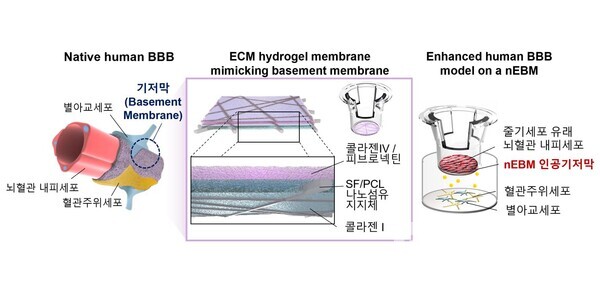
개발된 인공기저막은 생체친화적인 소재인 실크피브로인과 폴리카프로락톤으로 만들어진 수십, 수백 나노미터 직경의 나노섬유 지지체와 콜라겐 등의 기저막 유래 하이드로젤로 구성됐다. 혈액-뇌 장벽의 생체 기저막과 같은 얇은 박판의 3D 섬유구조를 가지며 플라스틱 다공성 막에 비해 백만배 낮은 수준의 기계적 강성을 가졌다.
연구팀은 개발된 나노섬유 멤브레인에 혈관내피세포, 별아교세포와 혈관주위세포를 공배양하여 인체 혈액-뇌 장벽의 생체 장벽 기능이 모사된 체외 모델을 성공적으로 구축했다. 연구팀은 세포가 나노섬유 멤브레인이 모사한 기저막의 물리적, 생화학적 자극에 반응하여 향상된 기능을 보임을 검증했다.
공동 1저자인 최정원, 윤재승 연구원은 “나노섬유 멤브레인을 이용한 혈액-뇌 장벽 모델의 높은 기능성은 체외모델 개발에서의 기저막의 물리적, 생화학적 모사의 중요성을 시사한다”며 “뇌질환 관련 약물 개발∙평가 뿐만 아니라 중추신경계 질환의 메커니즘 연구에 활용될 것으로 기대한다”고 밝혔다.
이번 연구 성과는 ‘바이오머티어리얼즈(Biomaterials)’ 온라인판 12월 23일자에 게재됐다.
[Summarizing in English]
UNIST and POSTECH Research Teams Present "Engineered Basement Membrane for Human iPS-Derived Blood-Brain Barrier"
On February 15, UNIST and POSTECH research teams, led by Professor Tae-eun Park at UNIST Biomedical Engineering faculties at UNIST and Professor Dong-sung Kim at POSTECH Engineering faculties presented "Human iPS-derived blood-brain barrier model exhibiting enhanced barrier properties empowered by engineered basement membrane."
The study is online published by Biomaterials on 23 December 2022, and the abstract is: The basement membrane (BM) of the blood-brain barrier (BBB), a thin extracellular matrix (ECM) sheet underneath the brain microvascular endothelial cells (BMECs), plays crucial roles in regulating the unique physiological barrier function of the BBB, which represents a major obstacle for brain drug delivery. Owing to the difficulty in mimicking the unique biophysical and chemical features of BM in in vitro systems, current in vitro BBB models have suffered from poor physiological relevance. Here, we describe a highly ameliorated human BBB model accomplished by an ultra-thin ECM hydrogel-based engineered basement membrane (nEBM), which is supported by a sparse electrospun nanofiber scaffold that offers in vivo BM-like microenvironment to BMECs. BBB model reconstituted on a nEBM recapitulates the physical barrier function of the in vivo human BBB through ECM mechano-response to physiological relevant stiffness (∼500 kPa) and exhibits high efflux pump activity. These features of the proposed BBB model enable modelling of ischemic stroke, reproducing the dynamic changes of BBB, immune cell infiltration, and drug response. Therefore, the proposed BBB model represents a powerful tool for predicting the BBB permeation of drugs and developing therapeutic strategies for brain diseases.
관련기사
- 유니스트, '탄소중립 관심도∙주가폭락 위험도' 반비례
- 유니스트, 내비게이션 기능 탑재된 'AR 콘택트렌즈' 만든다
- 유니스트(UNIST), 흐릿한 영상도 선명하게 복원한다... 왜곡 영상의 숨은 정보 활용
- UNIST, 암모니아를 수소 운반체로 활용하는 것이 경쟁력 있어
- UNIST, ‘1천조분의 1초' 금속-절연체 상변화 순간 포착하다
- UNIST, 손상된 DNA 복구 관여하는 새 단백질 ‘ZNF212’ 발견
- UNIST, 유독물질 '알데히드'를 '카복실산'으로 산화시키는 촉매 설계법 개발
- 포스텍, 고성능 플렉서블 패널용 박막트랜지스터 개발
- 유니스트, 그린수소 생산용 ‘초순수 수전해 촉매’ 개발
- 포스텍 연구팀, 회전기기 결함 탐지하는 AI 기술 개발
- UNIST∙고려대 연구팀, 광반응성 맥신 이온채널 개발
- UNIST, 비만 지방조직 생체모사칩 개발...비만 치료 기대
- 포스텍, 아파트 보일러가 이산화질소 주요 배출원
- 병원 방문 전 헤어제품으로 탈모치료 시도하는 사람 많아
- UNIST, '실리콘-흑연 음극재'가 '흑연 음극재'보다 빠르게 충전돼
- UNIST, 블루 수소 연계를 위한 타당성 분석 진행
- 포스텍∙조지아텍 연구팀, 약물 독성 관찰용 '체외 3D 인공 심장' 제작
- 포스텍, 백금 부식 완화로 연료전지 수명 늘려
- 한독크린텍-퀀텀캣, '금 나노촉매' 적용 신제품 개발 협력
- 포스텍, 세계 최대 정보량의 ‘메타홀로그램’ 구현