
'바이오하이브리드 3D 프린팅'으로 인공 심장 모델 제작
적은 양의 전기 판독 데이터로 수축력을 정량적으로 측정
체외에서 약물의 급성·만성 효과를 지속해서 관찰할 수 있어
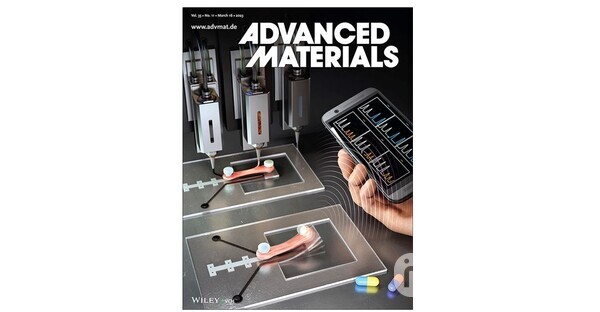
국내∙미국 공동 연구팀이 약물의 독성을 미리 관찰해 볼 수 있는 인공 심장을 3D 프린팅 기술로 제작하는 데 성공했다
포스텍(POSTECH∙총장 김무환)은 기계공학과‧IT융합공학과 장진아 교수, 기계공학과 정완균 교수‧김기훈 교수, 신소재공학과 정운룡 교수 등으로 구성된 포스텍 연구팀이 미국 조지아텍 여운홍 교수‧김호중박사 연구팀과의 공동연구를 통해 바이오하이브리드 3D 프린팅 기술로 약물의 심독성을 체외에서 관찰할 수 있는 인공 심장 모델을 프린팅했다고 17일 밝혔다.
약물 심독성은 약물 개발 초기 단계에서 주요 장애요인으로 여겨진다. 전임상 단계에서 심독성을 평가하는 체외 플랫폼은 다양하지만, 대부분의 심장 모델은 생리학적 관련성이 부족해 약물의 심독성을 예측하기 어렵다. 최근 심장의 생리적 수축을 모사할 수 있는 '3차원 인공 심장 조직(EHT‧Engineered Heart Tissue)'이라는 심장 모델이 등장했지만, 체외에서 약물의 급성·만성 효과를 지속해서 관찰하기에는 어려움이 있었다.
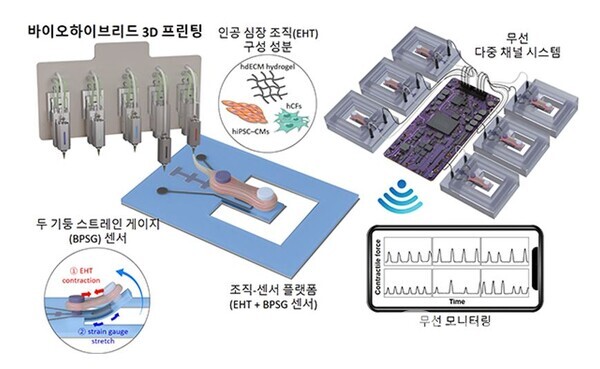
공동연구팀은 ‘바이오하이브리드 3D 프린팅(Biohybrid 3D Printing)’ 기술을 사용하여 인공 심장 모델을 제작했다. 두 개의 기둥 구조체를 스트레인 게이지 센서(BPSG Sensor‧Bipillar-Grafted Strain Gauge sensor)가 내장된 기판에 접목시키고, 이어 EHT를 센서에 통합시켜 '조직-센서 플랫폼(Tissue-Sensor Platform)'을 제작했다. 이렇게 제작된 플랫폼과 무선 다중 채널 전자 시스템을 이용하여 EHT 수축력을 지속적으로 모니터링하고, 약물의 급성·만성 심독성을 평가하는데 성공했다.
지금까지 체외 심장 모델의 수축력 모니터링 시스템의 경우, 높은 시간 해상도로 대량의 이미지 기반 데이터를 장시간 연속적으로 처리하는 데에는 한계가 있었지만, 이번에 개발된 조직-센서 플랫폼은 상대적으로 적은 양의 전기 판독 데이터로 수축력을 정량적으로 측정할 수 있어 장기간 연속 모니터링이 가능해졌다.
장진아 교수는 “이번에 개발한 바이오하이브리드 3D 프린팅 기술이 효과적인 약물 개발 과정을 위한 차세대 조직-센서 플랫폼을 제작할 수 있는 잠재적인 제조 방법이 될 것으로 기대한다”고 말했다.
한편, 해당 연구는 과학기술정보통신부-정보통신기획평가원(IITP)의 글로벌핵심인재 양성지원사업, 과학기술정보통신부-복지부 범부처재생의료기술개발사업, 산업부-한국산업기술평가관리원(KEIT)의 산업기술알키미스트프로젝트, 미국 국립과학재단(NSF)의 지원으로 수행됐고, 어드밴스드 머티리얼스(Advanced Materials) 3월 16일자 속표지 논문으로 게재됐다.
[Summarizing in English]
POSTECH and Georgia Institute of Technology Research Teams Present "Biohybrid 3D Printing of a Tissue-Sensor Platform for Monitoring of Drug-Induced Cardiotoxicity"
On March 17 (KST), POSTECH and Georgia Institute of Technology Research Teams, co-led by Prof. Jinah Jang and Woon-Hong Yeo present "Biohybrid 3D Printing of a Tissue-Sensor Platform for Wireless, Real-Time, and Continuous Monitoring of Drug-Induced Cardiotoxicity." The study published by Advanced Materials on 16 March 2023, and the abstract of study is: Drug-induced cardiotoxicity is regarded as a major hurdle in the early stages of drug development. Although there are various methods for preclinical cardiotoxicity tests, they cannot completely predict the cardiotoxic potential of a compound due to the lack of physiological relevance. Recently, 3D engineered heart tissue (EHT) has been used to investigate cardiac muscle functions as well as pharmacological effects by exhibiting physiological auxotonic contractions. However, there is still no adequate platform for continuous monitoring to test acute and chronic pharmacological effects in vitro. Here, a biohybrid 3D printing method for fabricating a tissue-sensor platform, composed of a bipillar-grafted strain gauge sensor and EHT, is first introduced. Two pillars are three-dimensionally printed as grafts onto a strain gauge-embedded substrate to promote the EHT contractility and guide the self-assembly of the EHTs along with the strain gauge. In addition, the integration of a wireless multi-channel electronic system allows for continuous monitoring of the EHT contractile force by the tissue-sensor platform and, ultimately, for the observation of the acute and chronic drug effects of cardiotoxicants. In summary, biohybrid 3D printing technology is expected to be a potential fabrication method to provide a next-generation tissue-sensor platform for an effective drug development process.