
조재흥 UNIST 교수팀, 알데히드 산화 반응의 새로운 경로 규명
유해물질 분해하는 촉매제 개발에 도움
미국 화학회지(Journal of the American Chemical Society) 게재
인체나 환경에 해로운 유독물질 '알데히드'를 '카복실산'으로 산화시킬 수 있는 금속 촉매 설계법이 나왔다.
UNIST(총장 이용훈)는 화학과 조재흥 교수팀은 요오도소 벤젠을 통해 ‘망간-요오도실벤젠 종’을 합성하고, 해당 합성 물질이 알데히드의 산화 반응에 관여하는 과정을 규명했다고 19일 밝혔다
알데히드 물질을 분해하는 것은 환경화학‧생화학 분야에서 중요하게 인식된다. 알데히드는 정유산업에서 부산물이나 일상생활에서 발생된다. 공기 중에 섞이면 대기오염을 유발하고, 생체 내에서는 유전자 독성을 가지며 돌연변이와 발암을 유발하는 물질로 알려졌다. 특히, 생체 내 알코올 분해 대사 과정에서 부산물로 형성되어 많은 영향을 미친다.
알데히드를 산화 시키기 위해선 과망간산칼륨(KMnO4) 등과 같은 강한 산화제나 강한 염기 조건을 통한 불균화 반응을 일으켜야 한다. 또한 반응을 개시하려면 화학 결합을 형성하기 위한 전자쌍 ‘친핵체’도 필요하다. 조재흥 교수 연구팀은 친핵체의 도움없이 알데히드를 카복실산으로 전환할 수 있는 금속 촉매를 개발했다.
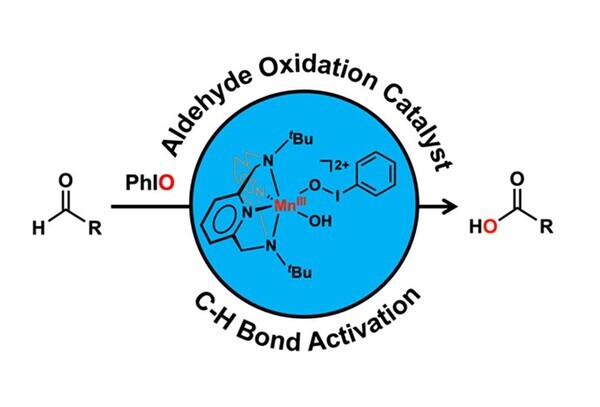
연구팀은 금속-활성산소 종의 하나인 ‘망간-요오드실벤젠 종’이 유독성의 알데히드 화합물을 카복실산으로 산화시키는 것과 이 반응이 새로운 친전자성 메커니즘에 따른 것이라는 것을 규명했다. 또한 반응속도론 연구를 통해 새로운 알데히드 산화 반응 기작을 제시했다.
제1저자인 정동현 UNIST 화학과 연구원은 “기존 알데히드 강한 산화 촉매를 이용한 산화 반응이 필요로 했다”며 “기존과는 다른 친전자성 공격을 통해 안정적으로 알데히드를 산화시킬 수 있는 촉매를 설계해 온화한 조건에서도 알데히드를 카복실산으로 전환할 수 있었다”고 말했다.
조재흥 화학과 교수는 “생체 모방 화학을 통해 합성한 ‘망간-요오도실벤젠 종’의 수소화이온 흡수 성질을 통해 새로운 알데히드 산화촉매를 개발했다는 점에서 학문적 의미가 크다”며 “이번 연구는 향후 환경 및 산업 분야에서 환경오염물질을 분해하는 촉매의 개발과 알데히드의 다양한 작용기로의 전환을 연구하는 데에 도움을 줄 것”이라고 전망했다.
해당 연구는 조재흥 교수 연구팀 정동현 연구원과 김효경 박사과정학생이 공동 1저자로 참여했으며, 연구결과는 2023년 1월 4일 ‘미국 화학회지(JACS, Journal of the American Chemical Society)’에 게재됐다.
[Summarizing in English]
UNIST Research Team Discovers Oxidation of Aldehydes into Carboxylic Acids
UNIST Research Team, leaded by Prof. Jae-heung Cho discovers the method of oxidation of aldehydes into carboxylic acids. The study published by JACS, Journal of the American Chemical Society on January 4, 2023, and the abstract of study is: The oxidation of aldehyde is one of the fundamental reactions in the biological system. Various synthetic procedures and catalysts have been developed to convert aldehydes into corresponding carboxylic acids efficiently under ambient conditions. In this work, we report the oxidation of aldehydes by a mononuclear manganese(III) iodosylbenzene complex, [MnIII(TBDAP)(OIPh)(OH)]2+ (1), with kinetic and mechanistic studies in detail. The reaction of 1 with aldehydes resulted in the formation of corresponding carboxylic acids via a pre-equilibrium state. Hammett plot and reaction rates of 1 with 1°-, 2°-, and 3°-aldehydes revealed the electrophilicity of 1 in the aldehyde oxidation. A kinetic isotope effect experiment and reactivity of 1 toward cyclohexanecarboxaldehyde (CCA) analogues indicate that the reaction of 1 with aldehyde occurs through the rate-determining C–H bond activation at the formyl group. The reaction rate of 1 with CCA is correlated to the bond dissociation energy of the formyl group plotting a linear correlation with other aliphatic C–H bonds. Density functional theory calculations found that 1 electrostatically interacts with CCA at the pre-equilibrium state in which the C–H bond activation of the formyl group is performed as the most feasible pathway. Surprisingly, the rate-determining step is characterized as hydride transfer from CCA to 1, affording an (oxo)methylium intermediate. At the fundamental level, it is revealed that the hydride transfer is composed of H atom abstraction followed by a fast electron transfer. Catalytic reactions of aldehydes by 1 are also presented with a broad substrate scope. This novel mechanistic study gives better insights into the metal oxygen chemistry and would be prominently valuable for development of transition metal catalysts.
관련기사
- 국내 연구팀, 류마티스성 관절염 치료법의 실마리 찾았다
- 유니스트(UNIST), 흐릿한 영상도 선명하게 복원한다... 왜곡 영상의 숨은 정보 활용
- 코트라스, 하지재활의료기기 ‘모빌라이즈(MOBILISE)’조기 상용화
- 인공지능(AI)으로 환자 맞춤형 항암제 효능 예측한다
- 과기정통부, '기술실용화 패스트트랙'으로 기술고도화 추진한다
- UNIST, 손상된 DNA 복구 관여하는 새 단백질 ‘ZNF212’ 발견
- UNIST, ‘1천조분의 1초' 금속-절연체 상변화 순간 포착하다
- UNIST, 암모니아를 수소 운반체로 활용하는 것이 경쟁력 있어
- 유니스트, 내비게이션 기능 탑재된 'AR 콘택트렌즈' 만든다
- 유니스트, '탄소중립 관심도∙주가폭락 위험도' 반비례
- UNIST-POSTECH, 나노섬유 멤브레인 활용한 혈액-뇌 장벽 모델 개발
- 삼성전자, 물 세척으로 20년동안 재사용할 수 있는 공기정화 필터 개발
- 유니스트, 그린수소 생산용 ‘초순수 수전해 촉매’ 개발
- 한독크린텍-퀀텀캣, '금 나노촉매' 적용 신제품 개발 협력
- 자동차용 유성도료 '휘발성유기화합물' 함유량 산정방법 개선...편법 방지