
단일 교차반응 센서의 복합신호에 AI 알고리즘 적용
30% 신축 범위에서 신축 방향과 변형량을 98% 정확도로 추출
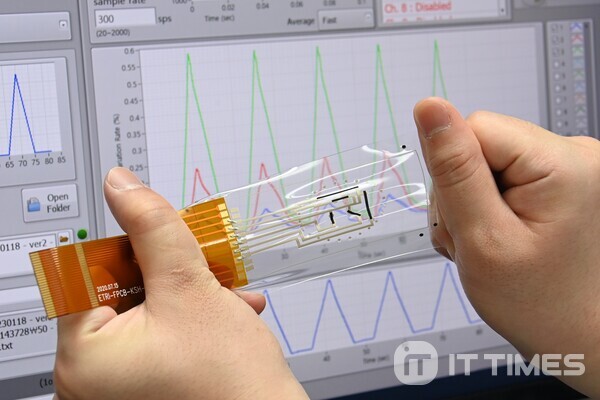
국내 연구진이 피부 센서에 인공지능(AI) 알고리즘을 적용하여 정확도와 신뢰성을 획기적으로 높였다.
한국전자통신연구원(ETRI)은 중앙대 연구팀과 함께 360도 전 방향에 걸쳐 늘어나고 줄어드는 신축량과 변형 방향을 98%의 정확도로 감지할 수 있는 스트레인(Strain) 센서를 개발했다고 8일 밝혔다.
기존 피부부착 스트레인 센서는 고무와 같은 신축성 소재와 그래핀, 탄소나노튜브(CNT) 등 전도성 나노소재를 더해 신축성 전도체 채널을 제작됐다. 채널이 늘어나고 줄면서 변화하는 전기 저항값으로 변형의 크기를 감지했다.
하지만, 미리 정해진 특정 방향으로 가해지는 변형만을 감지할 수 있어 같은 부위라도 상황에 따라 여러 방향으로 늘어나는 피부의 특성을 정확히 측정할 수 없다는 한계가 있었다.
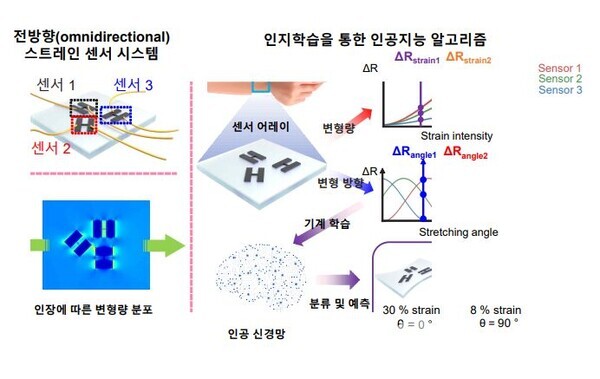
ETRI-중앙대 연구진은 세계 최초로 늘어나는 크기와 방향을 동시에 잴 수 있는 스트레인 센서를 제작했다. 또한, 인공신경망 구조를 이용한 AI 알고리즘을 적용해 크기와 방향을 98% 정밀도로 예측하는 데 성공했다.
기술의 핵심은 새로운 방향성 센서 구조다. 연구진은 일자 형태의 신축성 전도체 채널을 늘어나는 방향에 따라 저항 증감 특성을 나타내는 새로운 구조를 구현했다. 세 개의 센서는 서로 다른 방향으로 인접하게 배치하여 신호 조합으로 특정 부위의 신축 방향과 변형량을 동시에 뽑아낼 수 있게 구성했다
연구팀은 다양한 센서 데이터들을 인공신경망 알고리즘을 통해 학습∙분석해 신축 방향과 변형량을 98% 정확도(30% 신축 범위 내)로 추출할 수 있었다. 단일 교차반응 센서에서 얻어진 복합신호에 인지학습을 통한 AI 알고리즘을 적용, 다양한 감각 특성을 동시에 추출하는 방식을 보였다.
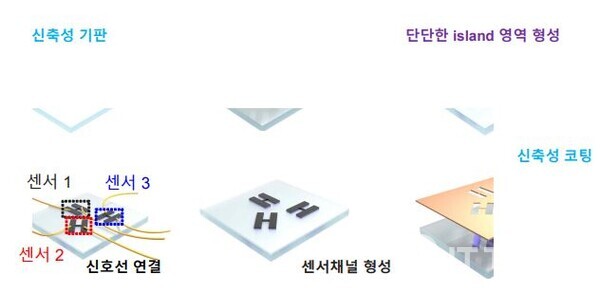
인쇄 공정을 통해 구현된 센서는 제작도 간편하다. 제작 단가가 낮고 제작 시간도 짧으며 저가 소재를 사용하므로 일회용 센서로도 활용 가능하다.
김성현 ETRI 플렉시블전자소자연구실 책임연구원은“연구진이 개발한 스트레인 센서는 간단한 구조로도 피부의 복잡한 변형 양상을 정확히 측정할 수 있어 전자피부가 필요한 분야에 폭넓게 활용이 가능할 것이다”고 말했다.
박성규 중앙대 교수도 “인공지능 알고리즘을 이용한 획기적인 시도로 인공지능 기반 시스템에 두루 응용될 수 있다”고 밝혔다.
센서에 사용된 소재들은 인체에 무해한 소재로 피부부착, 인체 동작 감지, 재활, 헬스케어, 로봇의 전자피부 등에 활용될 전망이다. 연구진은 3년 내 상용화를 목표로 향후 본 기술을 다양한 동작 하에서 근육 및 관절의 움직임 측정에 적용해 근골격 질환의 진단 및 상시 재활치료에 적용할 계획이라고 전했다.
해당 연구는 세계적 학술지‘어드밴스드 머티리얼즈(Advanced Materials)’ 온라인판 1월 5일자에 게재됐다.
[Summarizing in English]
ETRI AND CAU RESEARCH TEAM FINDS "HETEROGENEOUS STRUCTURE OMNIDRIECTIONAL STRAIN SENSOR ARRAY WITH COGNITIVELY-LEARNED NEURAL NETWORKS"
The research teams from ETRI, Chung-Ang University, Sungkyunkwan University, and University of Connecticut have found the "Heterogeneous Structure Omnidirectional Strain Sensor Arrays with Cognitively-Learned Neural Networks". The study published on Advanced Materials on 05 January 2023 edition, and the abstract of study is: Mechanically stretchable strain sensors have gained tremendous attentions in bio-inspired skin sensation systems and artificially intelligent tactile sensors. However, high-accuracy detection of both strain intensity and direction with simple device/array structures is still insufficient. To overcome this limitation, we propose an omnidirectional strain perception platform utilizing a stretchable strain sensor array with triangular-sensor-assembly coupled with machine learning-based neural network classification algorithm. The strain sensor, which is constructed with strain-insensitive electrode regions and strain-sensitive channel region, can minimize the undesirable electrical intrusion from the electrodes by strain, leading to a heterogeneous surface structure for more reliable strain sensing characteristics. The strain sensor exhibited decent sensitivity with gauge factor of ∼8, a moderate sensing range (0∼35%), and relatively good reliability (3,000 stretching cycles). More importantly, by employing a multiclass-multioutput behavior-learned cognition algorithm, the stretchable sensor array with triangular-sensor-assembly exhibited highly accurate recognition of both direction and intensity of an arbitrary strain by interpretating the correlated signals from the three-unit sensors. The omnidirectional strain perception platform with neural network algorithm exhibited overall strain intensity and direction accuracy around 98±2% over a strain range of 0∼30% in various surface stimuli environments.
관련기사
- 카이스트, 영상 복원 딥러닝 기술로 인공지능(AI) 신뢰도 문제 해결
- ETRI, 빛을 이용한 실리콘 포토닉스 핵심 기술 개발
- 코히런트(Coherent), ETRI, KAIST와 양해각서 체결
- 인쇄전자 파운드리기업 프래그매틱(PragmatIC), 3,500만 달러 추가 투자유치
- 태양 전지계의 다크호스, OPV(유기박막 태양전지) 시장 동향
- 헨켈(Henkel), 인쇄전자 센서로 건물 누수 감지한다
- 글로벌 원격의료 시장...2032년 48조∙연평균 17.3% 성장
- 글로벌 압전소자 시장...2030년 64조∙연평균 5.7% 성장
- 베바스토-카나투, 자율주행차 '루프 센서 모듈'에 인쇄전자 히터 통합한다
- 에피샤인-브릴리언트 매터스, '유기 실내 광전지∙배터리' 고도화 업무협약 체결