
EMT 하이브리드 상태를 피하는 동시에 항암 치료가 잘되는 상피세포 상태로 변환시키는데 성공
카이스트(총장 이광형)는 바이오∙뇌공학과 조광현 교수 연구팀이 폐암 세포의 성질을 변환시켜 암세포의 전이를 막고 약물에 대한 저항성을 제거할 수 있는 기술을 개발하는 데 성공했다고 30일 밝혔다.
연구팀은 분자 네트워크 수학모델을 구축해 '상피 세포'에서 '중간엽 세포'변환되는 과정에서의 세포를 관찰했다. 이를 통해 악성 종양으로 증식해 인접한 조직∙세포에 침입하는 '악성 인자'와 중간엽세포 상태에서 전이가 되지 않은 상피세포 상태로 다시 바뀔수 있도록 세포의 성질을 변환시켜주는 '양성 인자'를 발견했다.
특히 조 교수팀은 그동안 암치료의 난제로 남아있던 EMT(epithelial-to-mesenchymal transition: 상피-중간엽 전환) 하이브리드 상태를 피하는 동시에 항암 치료가 잘되는 상피세포 상태로 변환시키는데도 성공했다.
EMT 하이브리드 상태의 세포들은 상피세포와 중간엽세포의 특성을 모두 갖고 있어 약물저항성 및 전이 잠재성이 큰 것으로 알려져 있다. 높은 전이 능력과 약물저항성을 가지는 EMT 하이브리드 세포 상태를 회피하면서 암세포를 전이 능력과 약물저항성이 제거된 상피세포 상태로 온전히 역전시키는 것은 매우 어려운 일이었다.
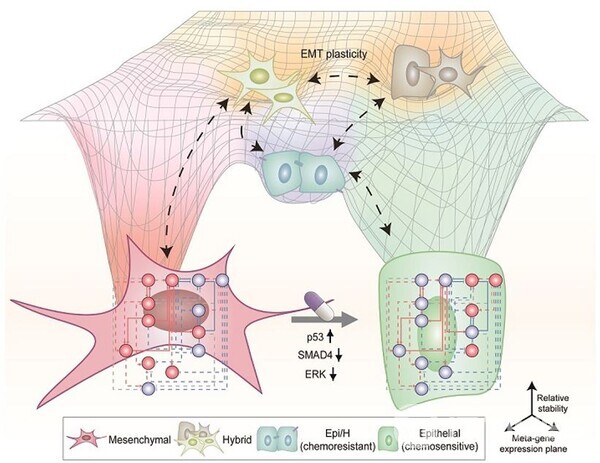
조광현 교수 연구팀은 복잡한 EMT를 지배하는 유전자 조절 네트워크의 수학모델을 정립했다. EMT 하이브리드 세포 상태를 회피하면서 상피세포 상태로 역전시킬 수 있는 ‘p53 (암 억제 단백질)’, ‘SMAD4 (SMAD 그룹에 포함된 단백질)’, ‘ERK1/2 (세포의 성장∙분화 조절인자)’ 등 3개의 분자타깃을 발굴했다. 이를 분자 세포실험에 적용해" 자극이 주어진 상황에서 중간엽세포 상태가 상피세포 상태로 역전될 수 있음"을 증명했다.
조광현 교수는 "높은 전이 능력과 약물저항성을 획득한 폐암 세포를 전이 능력이 제거되고 항암 화학요법치료에 민감한 상피세포 상태로 온전히 역전시키는 데 성공했다"라며 "암 환자의 예후를 증진할 수 있는 새로운 치료 전략을 제시했다ˮ라고 말했다.
앞서 조 교수 연구팀은 대장암세포를 정상 대장 세포로 되돌리는 연구 결과와 유방암세포를 호르몬 치료가 가능한 유방암세포로 리프로그래밍하는 연구에 성공한 바 있다.
이번 연구 성과는 미국암학회에서 출간하는 국제학술지 ‘캔서 리서치(Cancer Research)’ 온라인판 1월 30일자에 게재됐다.
[Summarizing in English]
KAIST Research Team Presents "Reversing EMT of Lung Cancer Cells while Avoiding Hybrid States"
On January 30, KAIST research team, led by Professor Cho Kwang-hyun of the Department of Bio∙Brain Engineering has presented "A Cell Fate Reprogramming Strategy Reverses Epithelial-to-Mesenchymal Transition of Lung Cancer Cells while Avoiding Hybrid States".
The study online published by Cancer Research on January 30, 2023, and the abstract is: The epithelial-to-mesenchymal transition (EMT) of primary cancer contributes to the acquisition of lethal properties, including metastasis and drug resistance. Blocking or reversing EMT could be an effective strategy to improve cancer treatment. However, it is still unclear how to achieve complete EMT reversal (rEMT) as cancer cells often transition to hybrid EMT states with high metastatic potential. To tackle this problem, we employed a systems biology approach and identified a core-regulatory circuit that plays the primary role in driving rEMT without hybrid properties. Perturbation of any single-node was not sufficient to completely revert EMT. Inhibition of both SMAD4 and ERK signaling along with p53 activation could induce rEMT in cancer cells even with TGF-β stimulation, a primary inducer of EMT. Induction of rEMT in lung cancer cells with the triple combination approach restored chemosensitivity. This cell-fate reprogramming strategy based on attractor landscapes revealed potential therapeutic targets that can eradicate metastatic potential by subverting EMT while avoiding hybrid states.
관련기사
- 카이스트 사족 로봇 '라이보', 물컹거리는 지형에서도 안정적으로 보행
- '차세대 3D 프린팅 소재'로 소형원자로 안전성 높인다
- 카이스트, 정확도 2배 높인 약물 상호작용 예측 수식 발견
- 카이스트, CES 2023 자율주행차 레이싱 참가... 아시아 유일팀
- 세계 최초 '사진에서 3차원 정보를 추론'해내는 AI 반도체 IP 개발
- 카이스트, 철제 벽면과 천장을 보행하는 사족 로봇 개발
- 카이스트, 피부 미백용 면 발광 마이크로 LED 패치 개발
- POSTECH, 안압 진단하고 안약까지 투여해주는 콘택트렌즈 개발
- 카이스트, 영상 복원 딥러닝 기술로 인공지능(AI) 신뢰도 문제 해결
- 카이스트, 집속 이온빔으로 초고해상도 LED 디스플레이 픽셀 구현
- CJ제일제당, 호주 바이오텍 스타트업 '프로벡터스 알지'에 투자
- 병원 방문 전 헤어제품으로 탈모치료 시도하는 사람 많아
- 카이스트, AI로 코로나19 치료제와 기존 약물 상호작용 예측
- 카이스트, 초고해상도 마이크로 LED 구조변경으로 발열 40% 낮춰
- 카이스트, 세계 최고 수준으로 '리튬금속전지' 수명 늘려
- 압타머사이언스-하이셀텍, 차세대 표적항암제 개발 업무협약 체결