
HLB's US subsidiary Elevar Therapeutics announced the updated Phase 3 CARES-310 study for uHCC at ASCO 2024.
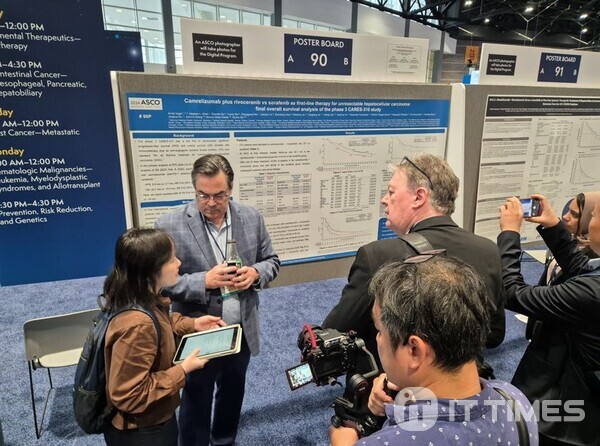
SEOUL, South Korea, June 3, 2024 (IT Times) - HLB, a leading biopharmaceutical company, today announced that the updated Phase 3 CARES-310 study evaluating a novel combination therapy with rivoceranib in unresectable hepatocellular carcinoma (uHCC) was presented as a poster at the American Society of Clinical Oncology (ASCO) 2024 meeting in Chicago. The results generated significant interest, with experts gathering to discuss the drug's potential to become a new standard treatment for liver cancer.
Promising Survival Rates and Tolerability Profile
The updated results showed a remarkably extended median overall survival (mOS) of nearly two years (23.8 months) in patients treated with the rivoceranib combination, compared to 22.1 months previously reported. This represents an improvement of 8.6 months over the current standard first-line treatment for uHCC.
The treatment was also well-tolerated, with manageable treatment-related adverse events (TRAEs) such as hypertension. The discontinuation rate due to TRAEs was minimal at 4.4% in the rivoceranib arm, compared to 4.8% in the control group, highlighting a favorable benefit-risk profile.
Expert Opinions Endorse Potential Paradigm Shift
"The global Phase 3 trial of rivoceranib plus camrelizumab is a significant breakthrough," said Ahmed Omar Kaseb, MD, of The University of Texas MD Anderson Cancer Center. "Not only does it demonstrate the longest patient survival ever observed in liver cancer treatment, but it also has the potential to significantly improve the standard of care for patients with this aggressive disease."
Dr. Richard Kim, Professor at Moffitt Cancer Center, Florida, echoed these sentiments. "Previously, overall survival for stage 4 liver cancer was less than 10 months, leading to treatment reluctance. The rivoceranib combination's nearly two-year median survival has the potential to significantly impact patients. Additionally, the oral formulation and lack of a pre-treatment endoscopy requirement offer clear advantages over existing therapies."

Competitive Advantages Over Existing Treatments
The rivoceranib combination addresses limitations associated with current treatments. One of the current treatments, while considered standard-of-care, has seen a decline due to gastrointestinal bleeding risks requiring endoscopies, a time-consuming procedure. The rivoceranib combination eliminates this need, offering greater patient convenience.
Furthermore, while the other recently approved treatment has fewer side effects, it has a lower median overall survival and is restricted to patients who respond to immunotherapy. Professor Arndt Vogel, European liver cancer expert and lead author of the study, emphasized, "The rivoceranib combination is not only superior in survival but also versatile, being effective for patients with diverse etiologies and reduced liver function."
Next Steps: FDA Approval and Market Access
Elevar Therapeutics, a wholly owned subsidiary of HLB actively promoted the new liver cancer drug at a prominent booth during ASCO 2024. The company plans to meet with the FDA soon to address potential minor facility-related deficiencies, in collaboration with Jiangsu Hengrui Pharmaceuticals. With a swift resolution anticipated, Elevar expects to receive new drug approval within the current year.
IT타임스 YoungHa Kim (yhkim@ittimes.com)
관련기사
- 리보세라닙 병용요법, 신장∙방광암 10대 연구결과 선정
- HLB 간암신약, 생존 기간 22.1개월에서 23.8개월로 늘어나
- HLB 리보세라닙, 유방암 환자 생존기간 개선 효과 보여
- HLB bioStep Unveils Global Expansion Plans
- HLB Panagene Expands Diagnostics Portfolio, Targets Global Market with Subsidiary BioSquare
- HLB Life Science Secures Exclusive Rights for Only FDA-Approved Vitamin C Injection in Korea and Japan