
The lunar mobility platform can carry various equipment on top of the rover with a maximum weight of 70 kg
The group aims to create a rover that has launch capability in 2027
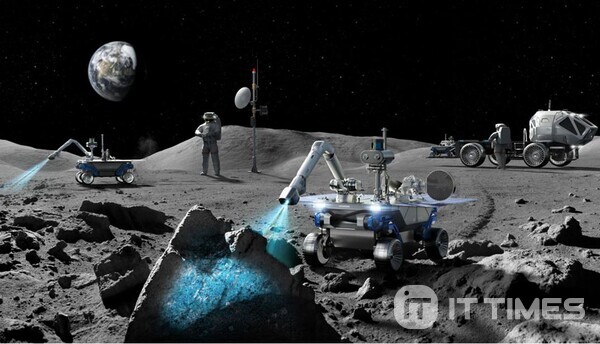
On April 20 (KST), Hyundai Motor Group has announced that it has begun building a development model for a lunar exploration rover, with major Korean research institutes in the aerospace sector.
Hyundai Motor Group's initiative to develop a rover for lunar exploration is aimed at contributing to the development of scientific research in Korea by securing technological capabilities in the space sector.
In July 2022, Hyundai Motor Group signed a multilateral joint research agreement (MOU) with six Korean space research institutes, including the Korea Astronomy and Space Science Institute (KASI), Electronics and Telecommunication Research Institute (ETRI), Korea Institute of Civil Engineering and Building Technology (KICT), Korea Aerospace Research Institute (KARI), Korea Atomic Energy Research Institute (KAERI) and Korea Automotive Technology Institute (KATECH), to develop a lunar rover.
Since then, Hyundai Motor Group has refined the direction of the initial lunar exploration mobility development model. The Group expects to complete the initial test unit as soon as the second half of 2024 and aims to create a model that has launch capability in 2027.
“Hyundai Motor Group has consistently stated its goal is to contribute to expanding human reach and the scope of human mobility experiences,” said Yong Wha Kim, Executive Vice President, and Head of R&D Planning & Coordination Center of Hyundai Motor and Kia. “The creation of the lunar exploration mobility development model not only reflects this goal, but also shows our ambition to achieve tangible results in the face of significant challenges. With the rover’s development, we are moving beyond land, sea and air mobility to expand into space mobility.”
Along with the news of the start of the lunar rover development, Hyundai Motor Group also released images of the rover development model concept.
The concept of the development model is a small autonomous mobility dedicated to lunar surface exploration, with a self-charging system through solar power and Hyundai Motor Group's cutting-edge autonomous driving technology. In addition, high-level technologies such as thermal management, radiation shielding devices, and metal drive wheels to withstand the extreme environment of the lunar surface, where the temperature difference between day and night can reach more than 300 degrees, will be jointly developed with top domestic research institutes.
The development model aims for a maximum weight of 70 kg and is divided into upper and lower parts. The upper part will mainly perform lunar surface exploration functions, while the lower part will utilize Hyundai Motor Group's innovative technologies as a drive system.
Once the lower part of the rover is developed, the consultative body expects it to function as a mobility platform, supporting an upper part that will hold a variety of advanced technologies for digging, excavation and human exploration of the lunar surface for resources. Ultimately, the goal is to deliver a universally applicable mobility platform to handle a variety of payloads.
Following development, testing and refinement, the plan is to land the rover near the South Pole area of the moon to carry out various scientific missions. The solar-powered, autonomous driving mobility unit will weigh around 70 kg.
Before the rover can be sent to the Moon, the Group will conduct mission-based performance testing of the development model in an environment similar to the Moon’s surface in preparation for lunar mission and make refinements based on the test results.
The Group is committed to expanding human reach and providing various innovative mobility solutions through robotics, artificial intelligence (AI) and autonomous driving technologies.