
무기물 압전 박막을 고온 열처리 후, 유연기판에 전사하여 혈압센서 제작
미세한 맥박 파형에서 정확한 혈압 측정하는 데 성공

국내 연구진이 유연 압전 혈압센서와 무선통신 회로를 내장할 수 있는 웨어러블 워치 형태의 시제품을 제작했다.
카이스트(총장 이광형)는 신소재공학과 이건재 교수 연구팀과 한국표준과학연구원, 가톨릭의대 협력 연구팀이 혈압 측정을 위한 고민감 웨어러블 유연 압전센서를 개발했다고 17일 밝혔다.
공동 연구팀은 마이크로미터(머리카락 굵기의 백분의 일) 두께의 초고감도 무기물 압전 박막을 딱딱한 기판에서 고온 열처리 후 유연 기판에 전사하여 혈압 센서를 제작했으며, 피부에 밀착해 혈관의 미세한 맥박 파형에서 정확한 혈압을 측정하는 데 성공했다.
이번 연구에서 개발한 혈압 센서는 가톨릭 병원에서 진행한 임상시험에서 수축기 혈압, 이완기 혈압에서 모두 자동전자혈압계 국제 인증 기준인 오차 ±5 mmHg 이하, 표준편차 8mmHg 이하의 높은 기준을 만족했다. 또한, 웨어러블 워치에 혈압 센서를 탑재해 연속적인 혈압 모니터링이 가능하게 됐다.
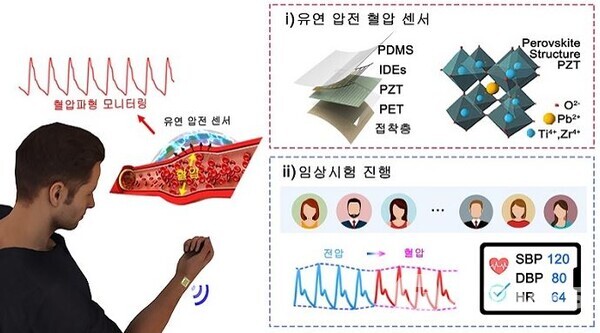
이건재 교수는 “이번에 개발된 웨어러블 워치 형태의 혈압 센서는 신뢰성과 내구성이 우수할 뿐만 아니라, 정확하고 연속적인 혈압을 측정할 수 있어 고혈압 환자들을 위한 헬스케어 시장에서 핵심적인 역할을 할 것으로 기대된다”며, “현재 패치 형태의 수면용 혈압 센서를 추가 개발한 후 창업을 통한 기술 사업화에 박차를 가하고자 한다”고 말했다.
해당 연구는 웨어러블플랫폼 소재기술센터, 휴먼플러스 융합연구개발사업, 바이오∙의료 융합 측정 표준기술개발 지원을 받아 수행됐으며, 국제 학술지 `어드밴스드 머티리얼즈(Advanced Materials)' 3월 24일자 온라인판에 게재됐다.
[Summarizing in English]
KAIST Research Team Discovered "Clinical Validation of Wearable Piezoelectric Blood Pressure Sensor for Continuous Health Monitoring"
On April 18 (KST), KAIST announced that the Research Teams, co-led by Prof. Keon Jae Lee (KAIST), Korea Research Institute of Standards and Science, The Catholic University of Korea discovered "Clinical Validation of Wearable Piezoelectric Blood Pressure Sensor for Continuous Health Monitoring." The study was published by Advanced Materials on 24 March 2023, and abstract is: Wearable blood pressure sensors have recently attracted attention as healthcare devices for continuous non-invasive arterial pressure (CNAP) monitoring. However, the accuracy of wearable blood pressure (BP) monitoring devices has been controversial due to the low signal quality of sensors, the absence of an accurate transfer function to convert the sensor signals into BP values, and the lack of clinical validation regarding measurement precision. Here, we report a wearable piezoelectric blood pressure sensor (WPBPS), which achieved a high normalized sensitivity (0.062 kPa−1), fast response time (23 ms) for CNAP monitoring. The transfer function of a linear regression model was designed, offering a simple solution to convert the flexible piezoelectric sensor signals into BP values. In order to verify the measurement accuracy of WPBPS, clinical trials were performed on 35 subjects aged from 20s to 80s after screening. The mean difference between the WPBPS and a commercial sphygmomanometer of 175 BP data pairs was -0.89 ± 6.19 mmHg and -0.32 ± 5.28 mmHg for systolic blood pressure (SBP) and diastolic blood pressure (DBP), respectively. By building a WPBPS-embedded wristwatch, we demonstrated the potentially promising use of a convenient, portable continuous BP monitoring system for cardiovascular disease diagnosis in this study.
관련기사
- 카이스트∙서울대∙부산대, '게놈 3차 구조' 신규 생성 원리 발견
- 카이스트, 다공성 소재 물성 예측하는 '멀티모달 인공 신경망' 개발
- 카이스트, 세계 최고 수준으로 '리튬금속전지' 수명 늘려
- 카이스트, 초고해상도 마이크로 LED 구조변경으로 발열 40% 낮춰
- 카이스트, AI로 코로나19 치료제와 기존 약물 상호작용 예측
- 카이스트, 집속 이온빔으로 초고해상도 LED 디스플레이 픽셀 구현
- 세그메드∙엔비디아∙라드이미지넷, 의료 데이터 상용화 협약 체결
- 카이스트, 이식형 실시간 심혈관 무선 측정 시스템 개발
- 헬시아이오, 가정용 신장질환 진단기로 '퓨처 디지털 어워드' 수상
- 스웨트코인, 2022년 피트니스 앱 다운로드 1위...1억2000만 돌파
- HLB, 파나진 300억 인수...암 진단사업 강화
- 카이스트, AI로 면역항암치료 부작용 예측