
티타늄 표면에 탄화티타늄을 입혀 부식 억제
탄소집전체 부식 억제를 통한 해수전지 성능 향상
국내 연구팀이 해수전지 탄소집전체의 부식을 억제하는 기술을 개발했다. UNIST(총장 이용훈)는 에너지화학공학과 이동욱 교수가 해수전지에서 집전체로 쓰이는 티타늄(Ti)의 표면에 티타늄카바이드(TiC)를 입혀 해수전지의 성능을 대폭 증가시키는 기술을 개발했다고 20일 밝혔다.
집전체는 전자가 이동하는 통로가 되는 소재를 일컫는다. 해수전지의 양극 집전체는 탄소 집전체와 티타늄 금속 집전체로 이뤄져있다.
티타늄 금속 집전체는 해수와 작용했을 때 안정성이 높으나, 탄소집전체는 부식현상이 종종 발생해 사이클 안정성을 약화시킨다. 싸이클 안정성 확보를 위해서는 탄소집전체의 부식을 억제하는 것이 매우 중요하다.
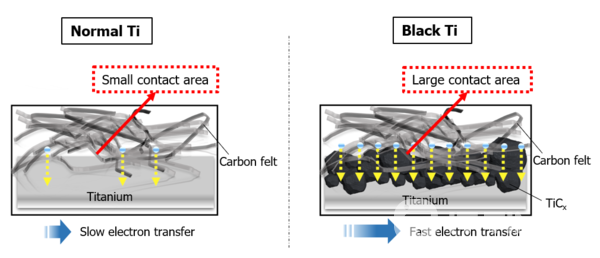
연구팀은 집전체의 부식을 막아 해수전지의 효율을 높이기 위해 티타늄에 탄화티타늄(TiC)을 코팅해 해수 환경에 적용해봤다. 연구결과 탄소집전체의 부식현상이 억제됐으며 탄화타이타늄을 입힌 티타늄은 해수환경에서 화학적, 전기화학적, 기계적 안정성을 보였다.
개발한 집전체를 해수전지에 이용할 경우 코인(coin) 타입 셀은 기존 대비 사이클의 성능은 4배, 출력 성능은 30% 향상됐으며 전압 간격은 20% 수준으로 감소했다. 또한 대용량 각(prismatic) 타입 셀에서도 출력 성능이 15% 증가하고 저항과 전압 간격은 각각 25%, 20%가 감소한다는 결과값을 도출했다.

제 1 저자인 조윤종 연구원은 “해수전지는 바닷물을 양극물질로 이용한 차세대 배터리 시스템이다”며 “이번 연구를 통해 간단한 방식으로 제작한 집전체가 해수전지뿐 아니라, 연료전지, 플로우 전지, 금속 공기 배터리 등의 상용화를 앞당기는 데 기여할 수 있을 것”이라고 기대했다.
해당 연구는 한국연구재단(NRF), 한국에너지기술평가원(KETEP)과 UNIST의 지원을 받아 수행됐고, 연구 결과는 국제학술지 '어드밴스드 펑셔널 머터리얼즈(Advanced Functional Materials)’ 2월 20일자에 온라인 게재됐다.
[Summarizing in English]
UNIST Research Team Develops "Prevention of Carbon Corrosion by TiC Formation on Ti Current Collector in Seawater Batteries"
On March 20 (KST), UNIST announced that its Research Team, led by Prof. Dong-woog Lee discovered "Prevention of Carbon Corrosion by TiC Formation on Ti Current Collector in Seawater Batteries" The study online published by Advanced Functional Materials on 20 February 2023, and the abstract of study is: Seawater batteries (SWBs) are a type of sodium-air batteries that use abundant seawater as the source of the catholyte. A cathode current collector in traditional SWBs is composed of titanium (Ti) and carbon-based current collectors. The high contact resistance between Ti and carbon-based current collectors as well as the slow kinetics of oxygen evolution and reduction reactions increase the overpotential, resulting in side reactions such as carbon corrosion. To enhance the performance of SWBs, previous studies have focused on carbon current collectors, catalysts, and polymer binders, while ignoring the importance of Ti. In this study, a facile carbon diffusion technique is employed to successfully form titanium carbide (TiC) on the surface of Ti. SWBs with engineered Ti demonstrate considerably improved performance (four times higher cycling stability, 30% increased power performance, 40% reduced voltage gap) in relation to those with pristine Ti. This significantly improved electrochemical performance is found to be attributable to the prevention of carbon corrosion due to i) the reduction of contact resistance (owing to rough TiC surface) and ii) the electrocatalytic effect of TiC. Finally, engineered Ti is applied to large-area SWBs and its potential applicability in energy storage systems is confirmed.
관련기사
- UNIST, 블루 수소 연계를 위한 타당성 분석 진행
- UNIST 지관서가에서 ‘챗GPT와 함께하는 세상' 특별강연 개최
- UNIST, '실리콘-흑연 음극재'가 '흑연 음극재'보다 빠르게 충전돼
- UNIST, 비만 지방조직 생체모사칩 개발...비만 치료 기대
- UNIST∙고려대 연구팀, 광반응성 맥신 이온채널 개발
- 유니스트, 그린수소 생산용 ‘초순수 수전해 촉매’ 개발
- UNIST, 암전이 유발 세포택배 '엑소좀' 생성원리 밝혀
- 비츠로셀, '이스라엘 아라드'에 216.6억 규모 전지 공급계약 체결
- UNIST, 배터리 '단결정 양극재' 제조비 줄이는 방법 찾았다
- UNIST-고려아연, 이산화탄소 포집 공동연구 협약 체결
- UNIST, '금속-유기 구조체' 활용한 차세대 다공성 물질 개발 전략 제시
- UNIST, 리튬이온배터리 상태 진단 모델 개발
- UNIST, 황화물 전고체전지용 유기물 코팅 소재 개발